Introduction
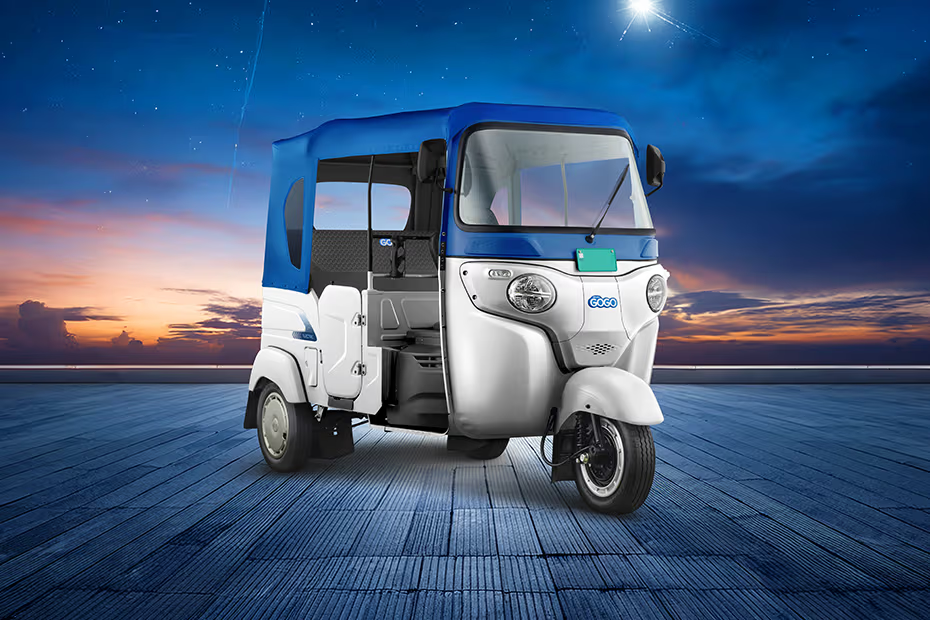
India’s electric three-wheeler segment has grown remarkably in recent years, driven by rising fuel costs, tightening emission norms, and strong government incentives under schemes like FAME II. Bajaj Auto — one of India’s most trusted and recognised vehicle manufacturers — has been at the forefront of this transition, developing electric auto-rickshaw solutions designed for commercial last-mile mobility. The Bajaj Gogo electric auto is among the offerings in this evolving segment, targeting fleet operators, individual driver-owners, and commercial logistics providers looking for a cleaner, more economical alternative to petrol and CNG three-wheelers.
Overview of Bajaj’s Electric Auto Lineup
Bajaj Auto has a long history in the three-wheeler segment with its RE series of auto-rickshaws, which have been ubiquitous in Indian cities for decades. The brand’s electric three-wheeler initiative extends this legacy into the zero-emission era. Electric auto-rickshaws from Bajaj are designed to handle the rigorous demands of commercial operation — multiple daily trips, frequent stops and starts, varied road conditions, and the need for low running costs. Bajaj’s electric autos feature robust chassis construction, regenerative braking systems to recover energy during deceleration, and battery packs suited to a full day of urban commercial operation. The Gogo variant is positioned for passenger last-mile use, with a covered cabin, seating for passengers, and adequate ground clearance for varied urban and semi-urban road surfaces.
Bajaj Gogo Electric Auto Price and Variants
The Bajaj Gogo electric auto is priced competitively within the electric three-wheeler segment to make commercial adoption accessible. Pricing varies depending on the battery configuration, subsidy eligibility under FAME II and state-level EV incentive schemes, and the financing structure used by the purchaser. As of available market data, the ex-showroom price of electric auto-rickshaws in the Bajaj lineup in this class ranges approximately between ₹2.5 lakh and ₹4.5 lakh depending on the variant and the applicable government subsidy deducted at point of sale. Prospective buyers are strongly advised to visit their nearest Bajaj dealership for the current on-road price specific to their state, as road tax, registration fees, and applicable EV subsidies vary significantly from one state to another and change periodically as government schemes are revised.
Range, Battery, and Charging Specifications
Electric three-wheelers designed for commercial use need sufficient range to cover a full working day without requiring a mid-day charge that interrupts income generation. The Bajaj Gogo electric auto is engineered with this in mind, offering a practical range per charge in typical commercial urban driving conditions that enables drivers to complete a full day’s earnings without range anxiety. Battery capacity, charging time, and range vary by variant — Bajaj offers configurations with different battery sizes that trade-off upfront cost against range. Charging is typically supported through standard AC charging compatible with home points and dedicated EV charging infrastructure. The charging time from low to full charge varies by battery pack size but is generally designed to be completed overnight, allowing the vehicle to be ready for the next day’s operations. Bajaj’s dealer network provides guidance on optimal charging practices that extend battery longevity over the commercial vehicle’s operating life.
Running Cost Comparison: Electric vs CNG vs Petrol
One of the most compelling arguments for adopting an electric auto like the Bajaj Gogo is the dramatically lower per-kilometre running cost compared to CNG and petrol alternatives. Electricity cost per kilometre driven is significantly lower than the equivalent CNG or petrol fuel cost at current market rates in India. Combined with negligible oil changes, reduced brake pad wear (due to regenerative braking), and fewer moving parts to maintain, the total cost of operation over the vehicle’s working life can be meaningfully lower despite the higher upfront purchase price relative to a basic CNG auto. For a commercial driver-owner running the vehicle eight to twelve hours a day, these savings accumulate quickly and can offset the price premium within a relatively short operating period. Government subsidies available at the time of purchase further reduce the effective upfront cost.
Who Should Consider the Bajaj Gogo Electric Auto?
The Bajaj Gogo electric auto is most suitable for urban and semi-urban commercial operators who cover predictable daily distances within the vehicle’s range capability. City-based auto-rickshaw drivers, small fleet operators running last-mile connectivity services, and businesses using three-wheelers for intra-city goods delivery are ideal candidates. The vehicle is particularly well-suited to cities with established EV charging infrastructure and active state subsidy programmes that reduce the acquisition cost. Rural operators or those covering long inter-city routes may find the range and charging infrastructure less suited to their needs and should carefully evaluate the vehicle’s specifications against their specific daily usage pattern before committing to a purchase.
Frequently Asked Questions
Is the Bajaj Gogo eligible for FAME II subsidies? Eligibility depends on current government scheme parameters — verify with the dealership. Can the battery be replaced if degraded? Yes — Bajaj provides battery replacement options through its service network. Is financing available? Yes — Bajaj Financial Services and partner banks offer commercial vehicle financing for electric three-wheelers.
Running Costs and Range: Is the Bajaj Gogo Worth It?
Beyond the purchase price, the Bajaj Gogo electric auto stands out for its significantly lower running costs compared to CNG or petrol-powered three-wheelers. Electricity costs per kilometre in India are a fraction of fuel costs — most operators report savings of ₹2 to ₹4 per kilometre compared to CNG equivalents, which can translate to substantial monthly savings for drivers covering 80 to 120 kilometres daily. Charging from a standard domestic connection takes several hours for a full charge, and many operators charge overnight during off-peak hours when electricity tariffs are lower. The Gogo’s range on a full charge is suitable for urban and semi-urban passenger routes, making it well-matched to the typical operational pattern of an auto-rickshaw in Indian cities. Battery health and warranty coverage are important considerations for fleet operators, and Bajaj’s service network across India provides a meaningful advantage in terms of parts availability and trained technician access.
Conclusion
The Bajaj Gogo electric auto represents the intersection of Bajaj’s decades-long three-wheeler expertise and the electric mobility revolution reshaping Indian urban transport. For commercial operators seeking lower running costs, cleaner operation, and access to government EV incentives, it offers a compelling proposition — provided buyers carefully evaluate range specifications, local charging access, and current pricing including applicable subsidies through an authorised Bajaj dealership.
⚠ Disclaimer
This article is for informational purposes only. Prices, specifications, and government subsidy eligibility are subject to change. The Bajaj Gogo electric auto price stated is approximate and may differ from current dealership pricing in your state. Always consult an authorised Bajaj dealer for the most accurate and up-to-date pricing, specifications, and subsidy information before making a purchase decision.